
The Solution for Cleaner Air in the Food Industry – Particle and Odor Removal in Frying

3 February 2025

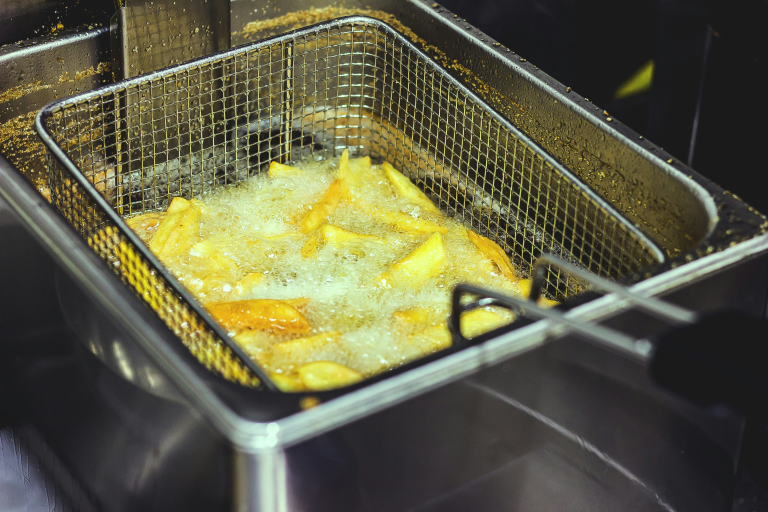
Efficient air purification is essential in frying applications to ensure a clean and sustainable production process. By combining centrifugal particle separation with ColdOx™ technology, both particulate matter and odorous VOC emissions can be effectively removed. This not only improves air quality but also enables heat recovery, reduces maintenance, and lowers energy consumption. Discover how our integrated solution enhances efficiency, minimizes operational costs, and ensures compliance with strict environmental regulations.

The first treatment step in all Frying applications is the removal of particles using a Centrifugal Separator. If further odour removal is needed (the particles carry part of the odour) and/or if VOC removal is required, a CentrOx™ system is used in which the centrifugal separator is integrated with our ColdOx™ technology. The efficient removal of particles allows for heat recovery using highly efficient Heat Exchangers, frequently installed in Frying applications in combination with the cleaning system.

The combination of centrifugal particle separation and oxidation of VOC and odours using the ColdOx™ technology, solves air treatment problems in the most difficult Frying processes, while reducing operation and maintenance cost compared to traditional solutions such as filters, scrubbers and incinerators.

The Centrifugal Separator operates continuously and rapidly evacuates the separated oil particles. The oil can in many cases be returned to the fryer and reused.

In the next step, the energy is recovered from the gas. This is achieved in an efficient heat exchanger that condenses the water vapour in the gas to water, while the heat is transferred to heat users in the factory (pre-heating of oil, blanching, tap water, heating of building etc.) and the water is recovered.

Finally, the gas is treated in the ColdOx™ unit in which gaseous compounds are removed along with the remaining odours.

In Meat Frying, the ColdOx™ treatment step is usually required due the high prevalence of gaseous highly active odour compounds. In Potato and Snack Frying, emission problems are typically more restricted to particle emissions but in certain processes and when restrictions on odour emissions are stringent, a ColdOx™ unit may be required.
In Meat Frying, the proper dimensioning of the Centrifugal Separator system is critical given the small particles in the exhaust gas. In addition, due to the sticky nature of the particles, a CIP™ should be installed to guarantee that the separators are kept clean.

Benefits

  • High particle separation performance (100% removal of particles > 1µm)
  • Efficient removal of gaseous compounds and odours.
  • Low maintenance and maximum process uptime.
  • Cleaner piping and reduced fire hazard.
  • Low energy consumption
  • Efficient heat recovery
  • Compact installation

Learn more about industrial odour control here.

More Blog posts

Centriairs early development was covered in article and youtube lecture

This week, Exportcenter Väst published an article highlighting Centriair’s early development and export journey. The article explains that although Centriair is based in Scandinavia, the company’s true growth lies in the international market. Great Britain and Germany were the first steps into Europe, and today Spain, Portugal, and North America are flourishing markets.

Centriair Debuts in Italy with Groundbreaking Odour Removal Rate

In the heart of Puglia’s olive country, Centriair has taken a major step into the Italian market with the installation of its 1st air treatment system at BelAgri’s biomethane and fertilizer facility in Candela. The challenge was as clear as the southern skies — to keep odours under control in a plant running close to the local community outdoors and under the region’s scorching summer heat. The suggested biofilter  would require constant maintenance and because of that would fail to meet the strict odour emission limits of 300 OU/m3 at the outlet, leading to constant unrest among nearby residents.

How Is Industrial Odour Measured?

Odour is a significant challenge in sectors such as waste management, food processing, biogas production, slaughterhouses, rendering plants, and wastewater treatment. These industries generate strong and persistent odours. If not properly managed, these odours can affect employees, nearby communities, and the overall perception of the industry,